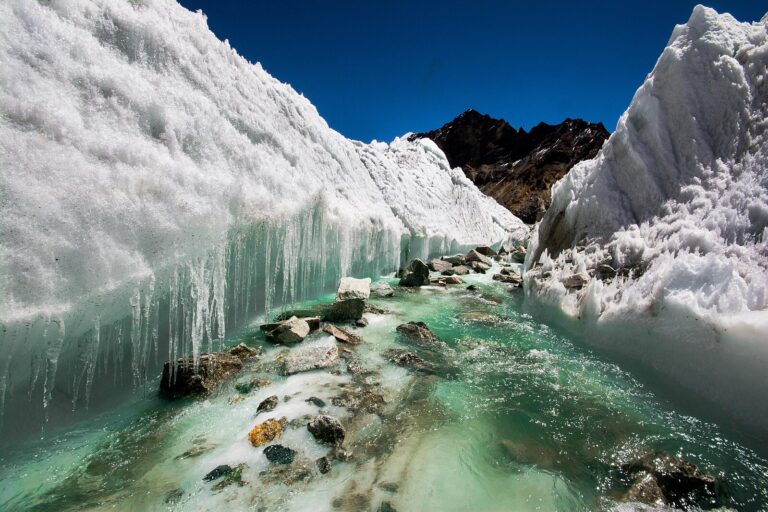
At the landmark Paris climate agreement, nearly every country in the world pledged to a goal to limit warming to well below 2° Celsius (3.6° Fahrenheit) above preindustrial levels by 2100, and work toward a more ambitious goal to limit warming to 1.5°C (2.7°F). The hope is that such a limit will help Earth avoid the most catastrophic effects of climate change. However, a recent review suggests that even the more ambitious ceiling of 1.5°C may be too warm for the planet’s polar ice sheets and trigger massive sea level rise. Researchers looked at paleoclimate data to see what the sea level was when Earth in the past was at a temperature comparable to the present. They combined that information with modeling data and more recent observations to then assess how much ice loss can be expected with 1.5°C of warming. The world is currently about 1.2°C (2.2°F) warmer than it was before humans began emitting massive amounts of warming fossil fuels, or pre-1900. Even at the current warming, “in the last few years, we’ve just seen some really dramatic changes in the Greenland ice sheet and the West Antarctica ice sheet in particular,” Chris Stokes, the study’s lead author, from Durham University, U.K., told Mongabay in a video call. He added researchers were surprised by the amount of melting they’ve observed already. The hope has been that 1.5°C of warming is below the threshold for massive glacial melting. So, “we wanted to see what the impact of 1.5 degrees…This article was originally published on Mongabay