The Women in Energy Network (WIEN) on Tuesday, November 25, 2025, outlined a bold, future-focused agenda at a pre-AGM media briefing in Lagos, placing emphasis on building a sustainable talent pipeline, reshaping policy conversations, and redefining the role of women across Nigeria’s rapidly evolving energy value chain.
Ahead of its 2025 Annual General Meeting scheduled for November 25, WIEN’s leadership highlighted how the organisation is shifting from simply creating opportunities for women to actively engineering pathways that connect young girls, early-career professionals, and senior executives into a cohesive ecosystem of advancement.
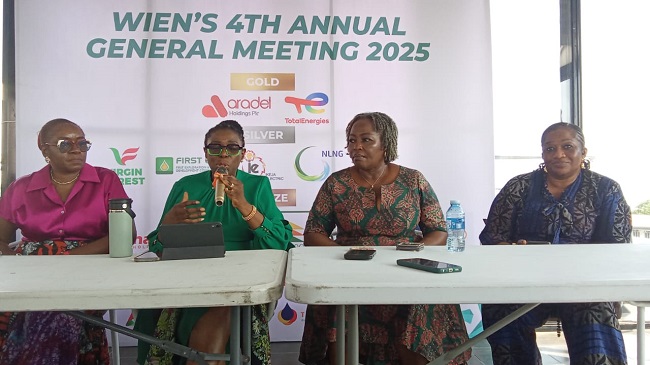
WIEN President, Eyono Fatayi-Williams, said the network’s growth – now surpassing 1,008 lifetime members – signals not only expanded reach but a deepening commitment to structural influence.
“We’re no longer just participating in the energy sector – we are shaping it,” she told journalists. “From policy tables to international stages, WIEN has become a strategic voice advocating for the future of Nigeria’s energy workforce.”
A significant theme emerging from the briefing was WIEN’s intentional focus on the full talent spectrum, beginning with STEM education in primary and secondary schools.
WIEN Executive Secretary, Asanimo Omezi, outlined how the network is cultivating tomorrow’s female engineers, having reached more than 500 girls in Lagos, Port Harcourt, and Rivers State through hands-on STEM initiatives, mentorship engagements, and NLNG-supported outreach.
“Our philosophy is simple: if girls don’t enter STEM early, they don’t enter the energy workforce at all,” Omezi said.
The organisation is now developing a coordinated STEM impact framework – designed to align what schools need, what corporations can support, and what the sector demands by 2026.
Beyond STEM, WIEN expanded opportunities for emerging professionals with the WINs IWD Career Fair in Lagos and Port Harcourt, linking young women and collegiate members to employers such as Aradel Holdings and major regulatory bodies.
Corporate engagement also deepened, with WIEN welcoming TotalEnergies as its first International Oil Company member – a signal that gender inclusion is becoming a priority for top-tier industry players.
Another strategic front where WIEN is asserting influence is national policy engagement.
The network contributed at the NCDMB Stakeholders’ Engagement Forum, where discussions on Nigeria’s energy transition, local content strategy, and regulatory bottlenecks are increasingly shaping the sector’s direction.
WIEN’s role, Fatayi-Williams noted, is “not to observe policies – but to help inform them.”
The network also introduced the ETE Taxation Platform to help women-led energy businesses improve compliance – a barrier that often limits growth and access to opportunities.
Through strengthened structuring and the creation of sub-sector committees, WIEN is tailoring support to the realities of each energy segment.
WIEN Vice President (Upstream), Ifeoma Ukabiala, emphasised that while midstream and downstream sectors are seeing gradual improvements in female representation, upstream still requires deliberate, sector-wide effort.
“Upstream roles demand visibility, confidence, and sponsorship,” she said. “Women don’t just need opportunities – they need champions advocating for them in spaces they are not yet present.”
She called for mindset shifts among both men and women, stressing that confidence and sponsorship often determine who advances.